




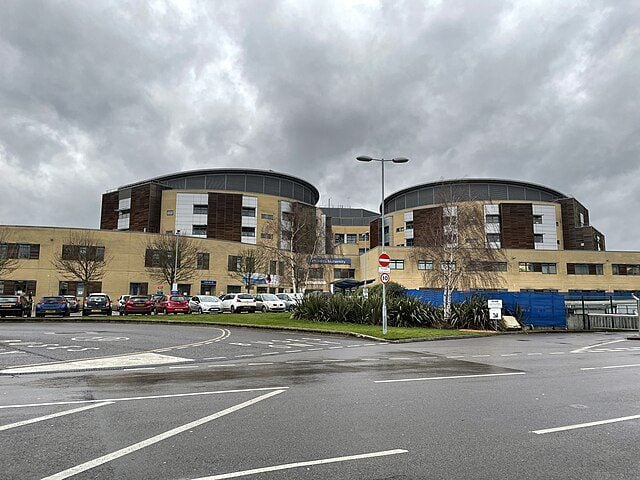
Queen’s Hospital in Romford is seeking £35 million in funding to transform its accident and emergency department and eliminate corridor care, as the facility grapples with unprecedented demand.
The hospital, which holds a Care Quality Commission rating of “requires improvement” for its urgent services, experienced its busiest month on record in December. An average of 995 people attended A&E daily, making it the third busiest month in the hospital’s history.
Last year alone, the department saw 14,286 additional attendees, contributing to what officials describe as record demand.
Footage broadcast by ITV in December highlighted the severe pressures facing the hospital, showing packed corridors with elderly patients apparently left for days and some undergoing examinations in public view.
Matthew Trainer, Chief Executive of Barking, Havering and Redbridge University Hospitals Trust, which operates Queen’s Hospital, acknowledged the situation. “As I said to the broadcaster, corridor care isn’t right or fair and it’s not something I would want for one of my relatives,” he said.
Mr Trainer explained that the practice was occurring because of rising patient numbers. “It is safer to bring people into the hospital rather than keeping them waiting outside on ambulances for hours, as happened in the past,” he added.
Andrew Rosindell, MP for Romford, has thrown his support behind the funding campaign, describing it as “necessary” for transforming urgent and emergency care services.
“On the many visits that I have made to the hospital in my capacity as the MP for Romford, I have seen first-hand the lifesaving work of the team at Queen’s, but I’m afraid that the resources are simply not there to meet ever-increasing demand,” Mr Rosindell said. He urged residents to join the campaign and “show their support for this vital cause.”
Maternity Services Show Improvement
Whilst urgent care faces challenges, Queen’s Hospital has made notable progress in maternity services, which now hold a “good” rating from the CQC. The unit is the third largest single-site maternity department in England, delivering 7,002 babies in 2025.
According to Mr Trainer, improvements include additional midwives and medical staff in the triage area, with a dedicated senior doctor in obstetric triage—a feature found in only a few units. The hospital has also introduced 24-hour flow coordinators to reduce delays and innovative theatre use to address rising demand for caesarean sections.
CQC inspectors noted in their August report that senior leaders in the maternity department possess the “skills, knowledge, experience and credibility to lead effectively. They did so with integrity, openness and honesty.”
London-Wide Pressures
The pressures at Queen’s Hospital reflect broader challenges across the capital. The London Ambulance Service recorded its busiest month ever during the winter period, whilst health officials noted ongoing high numbers of flu and norovirus patients.
However, NHS England reports some positive developments. London hospitals reduced treatment waiting lists by over 62,000 people in November, despite record winter demand. Cancer care also showed progress, with nearly 80 per cent of patients receiving diagnosis or clear results within the four-week target, according to the latest figures.
Homerton Healthcare in East London achieved the region’s highest backlog reduction at 9.4 per cent, driven by new surgical lists and integrated community care.
Dr Em Rowland, Chief Operating Officer for Homerton Healthcare NHS Foundation Trust, said: “We’re pleased to see our waiting times moving in the right direction. This reflects the hard work of our clinical teams, operational staff, and the invaluable partnership of colleagues across the system.”
She added that whilst the results were positive, the trust remained “mindful of the pressures facing the wider health and care system and the importance of ensuring our progress is sustainable for both patients and staff.”
