

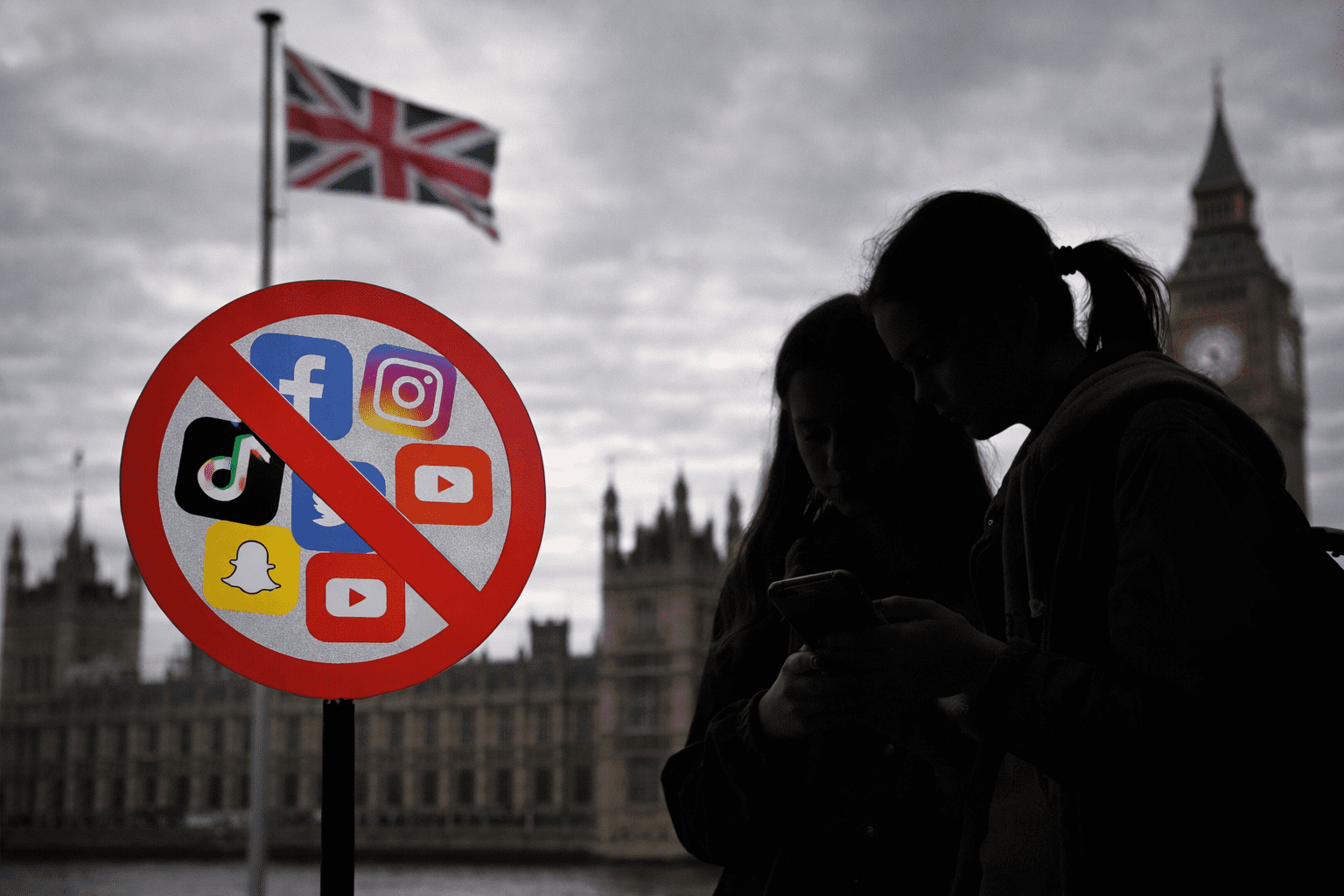
The UK government has announced plans to launch a consultation on whether social media use should be banned for children under the age of 16, with a formal response expected this summer.
The move follows Australia’s introduction of a similar ban in December 2025, described as the first such law in the world. Several other countries are now reported to be considering comparable measures.
Consultation and Timeline
The Department of Science, Innovation and Technology said the process will “seek views from parents, young people and civil society” on how effective such a ban might be. The consultation will also examine whether social media companies should be required to introduce more robust age verification checks.
Technology Secretary Liz Kendall stated that existing laws in the Online Safety Act were “never meant to be the end point” and that “parents still have serious concerns” about children’s online safety.
“We are determined to ensure technology enriches children’s lives, not harms them – and to give every child the childhood they deserve,” she said.
As part of immediate action, the government plans to give Ofsted new powers to check schools’ policies on mobile phone use, with an expectation that schools will be “phone-free by default”. Ofsted will also issue tougher guidance aimed at reducing phone use, including instructing staff not to use their own phones for personal reasons in front of pupils.
Parliamentary Pressure
The House of Lords is expected to vote on Wednesday on a proposed ban via an amendment to the Children’s Wellbeing and Schools Bill. The amendment has attracted support from former children’s TV presenter Baroness Benjamin and former education minister Lord Nash.
A separate amendment would introduce film-style age ratings for social media, potentially restricting which apps children can access.
Political Response
Conservative leader Kemi Badenoch described the consultation as “more dither and delay” from Labour, saying her party would introduce a legal social media ban for under-16s if it were in power.
“The prime minister is trying to copy an announcement that the Conservatives made a week ago, and still not getting it right,” she argued.
Liberal Democrat education spokeswoman Munira Wilson warned that “there is no time to waste in protecting our children from social media giants” and that “this consultation risks kicking the can down the road yet again.”
Education Sector Views
National Education Union general secretary Daniel Kebede welcomed the move as a “welcome shift”, saying that “every day, parents and teachers see how social media shapes children’s identities and attention long before they sit their GCSEs, pulling them into isolating, endless loops of content.”
The Association of School and College Leaders also welcomed the consultation but criticised the government for being “sluggish” in dealing with online risks to children. General secretary Pepe Di’Iasio said there is “clearly a much wider problem of children and young people spending far too much time on screens and being exposed to inappropriate content.”
However, Paul Whiteman, general secretary of the National Association of Head Teachers, objected to Ofsted’s proposed enforcement role, calling the suggestion that Ofcom should “police” phones in schools “deeply unhelpful and misguided”.
“School leaders need support from government, not the threat of heavy-handed inspection,” he added.
Divided Expert Opinion
More than 60 Labour MPs have written to the prime minister calling for action on social media use by children. The intervention was accompanied by calls from Esther Ghey, mother of murdered teenager Brianna Ghey, urging the government to act.
In a letter seen by the BBC, Mrs Ghey wrote that “some argue that vulnerable children need access to social media to find their community,” but stated, “as the parent of an extremely vulnerable and trans child, I strongly disagree.”
She said that in Brianna’s situation “social media limited her ability to engage in real-world social interactions” and that her daughter “had real friends, but she chose to live online instead.”
However, a group of 42 individuals and organisations, including the NSPCC, Childnet and the Molly Rose Foundation, have argued that an outright ban would be “the wrong solution”. They wrote that such a ban “would create a false sense of safety that would see children – but also the threats to them – migrate to other areas online.”
Professor Amy Orben, who leads the Digital Mental Health programme at the University of Cambridge’s MRC Cognition and Brain Sciences Unit, told the BBC there is “broad agreement” that more must be done to keep children safe online, but said there is still “not strong evidence” that age-based social media bans are effective.
Dr Holly Bear of Oxford University, whose work focuses on mental health interventions for young people, agreed that the evidence on the impact of a social media ban is “still unfolding”. She suggested that “a balanced approach might be trying to reduce algorithm-driven exposure to harmful content, improving safeguards, supporting digital literacy and carefully evaluating any major policy interventions.”
Potential Measures
According to the consultation’s scope, social media firms could be compelled to introduce stronger age-verification checks if a ban goes ahead. They could also be required to remove or restrict features “which drive compulsive use of social media,” targeting design elements that keep children engaged online for extended periods.
Trending
- Kilburn Murder: Police Release Witness Images in Appeal for Info
- Car Bursts Into Flames on Whitehorse Road, Croydon Exclusive Footage
- Two London Rail Lines Shut After Fire Destroys Cars and Caravan
- British Army Runs Secret Wargames Beneath Central London
- £30m Crackdown Targets Crime Gangs Hidden on Britain’s High Streets
- London protests: £4.5m operation keeps rival marches apart
- Met urges woman raped outside Streatham flats to come forward
- East London imam jailed for life over decade of rapes and sex attacks
Government to Consult on Social Media Ban for Under-16s

James Whitmore
Covers UK politics, government policy, and parliamentary affairs with a focus on accuracy, balance, and public accountability.
Add A Comment