




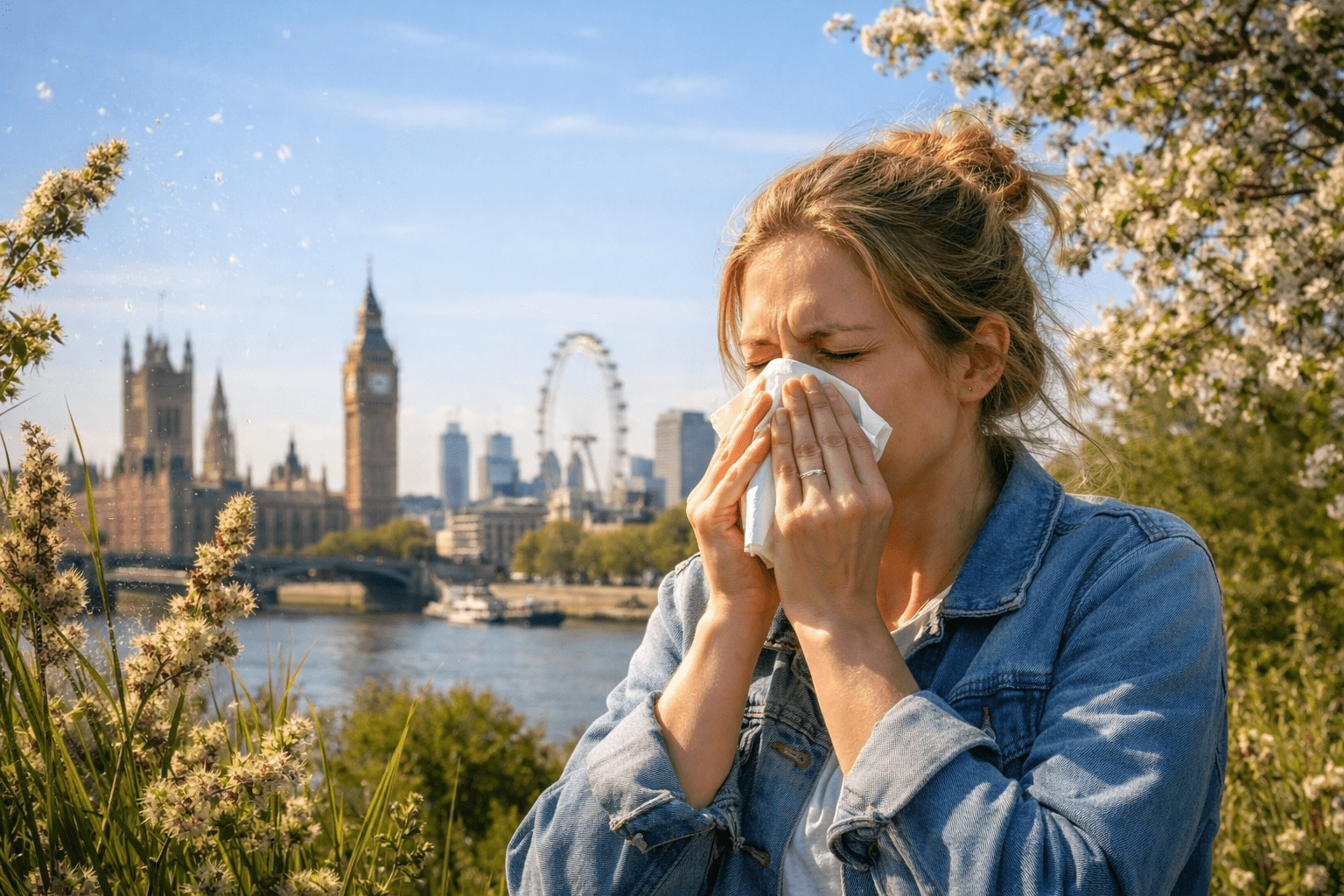
Millions of Londoners have spent the past fortnight reaching for antihistamines earlier than they can remember. The reason is not imagination. Britain has just recorded its warmest start to April in eighty years, with temperatures briefly pushing past 26°C in the south-west of the capital, and the Met Office has confirmed that tree pollen levels across central and southern England are now running at high or very high, with birch pollen becoming increasingly dominant alongside ash and the first traces of oak.
For an estimated 13 to 16 million hay fever sufferers in the UK — roughly one in five adults — the 2026 season has arrived with unusual speed and intensity. And Londoners, thanks to a peculiar combination of geography, street planting and traffic pollution, are among the first to feel it.
The urban problem Londoners can’t escape
Unlike the countryside, where pollen disperses across open land, London traps it. The city’s street canyons, tall buildings and relatively still air create localised hotspots where pollen grains accumulate for hours. Traffic-induced turbulence repeatedly lifts settled grains back into the breathing zone, meaning that even on days when the regional forecast reads “moderate”, pedestrians on Oxford Street or the Euston Road may be exposed to levels far higher than the map suggests.
The capital’s signature tree compounds the problem. London plane (Platanus × acerifolia), the hybrid that lines thousands of streets from Kensington to Hackney, releases not only pollen but also fine seed hairs that irritate the respiratory tract. Anyone who has walked through a leafy London street on a breezy April day and felt their throat tighten has met the plane tree’s second, less advertised export.
Add diesel particulates to the mix — still present despite ULEZ expansion — and the equation becomes worse. Research over the past decade has consistently found that air pollution coats pollen grains in ways that make them more allergenic, which is part of the reason why the same birch pollen count can feel significantly more miserable in Camden than in the Cotswolds.
Why 2026 feels different from 2025
Three factors have converged this year.
First, the compressed start. Much of January and early February were cool and damp, which kept alder and hazel catkins dormant. The weather then flipped at the end of February, with dry, sunny days pushing temperatures above 18°C in parts of the south-east. Pollen that had accumulated over weeks was released in a short burst rather than gradually, producing the very high alder counts reported across southern England in late February.
Second, the post-Easter warmth. The unusually hot spell in the second week of April — the warmest such period in 80 years, according to provisional Met Office data — has pulled birch pollen forward by roughly two weeks in the south. Silver birch (Betula pendula) is the most clinically significant tree pollen in northern Europe, and London, with its generous park plantings, has no shortage of it.
Third, what is coming next. If April and May stay mild and wet, as current weather models suggest, grass will grow vigorously through the late spring, setting the stage for very high grass pollen counts once the sun returns in June and July. Grass pollen affects around 90 per cent of UK hay fever sufferers. The early tree season may therefore be a prelude, not a peak.
The thunder-fever risk
One phenomenon worth watching is thunderstorm asthma, sometimes called “thunder fever”. It occurs when humid, stormy weather coincides with high grass pollen: humidity causes pollen grains to absorb water and rupture into far smaller particles that can be inhaled deep into the lungs. A widely reported incident in 1994 sent thousands of Londoners to A&E over a single weekend, and the summer 2026 set-up — abundant grass growth followed by the likelihood of thundery breakdowns — is exactly the sort that raises the probability. Anyone with both hay fever and asthma should ensure a reliever inhaler is within reach during any early-summer thunderstorm warning.
What actually works — and what mostly doesn’t
The NHS and allergy specialists broadly agree on a layered approach, and starting early matters far more than most sufferers realise.
Antihistamines such as cetirizine or loratadine, taken daily rather than only on bad days, form the foundation. Second-generation, non-drowsy versions are widely available over the counter and have a strong safety record. Steroid nasal sprays — fluticasone, beclomethasone, mometasone — are more effective than antihistamines for nasal symptoms but take up to two weeks to reach full effect, which is why clinicians recommend beginning them before the season rather than when symptoms are already severe. Eye drops containing sodium cromoglicate can substantially improve itchy, watery eyes and are often overlooked.
The physical measures are less glamorous but real. Wraparound sunglasses keep pollen out of the eyes during the morning commute. A thin smear of petroleum jelly around the nostrils traps grains before they are inhaled. Showering and changing clothes on returning home prevents pollen being carried to the sofa and the pillow. Bedroom windows are best kept shut during the early morning, when central London counts typically peak between 5am and 10am as warming air lifts pollen into the atmosphere.
What tends not to work on its own is waiting until symptoms become unbearable and then taking a single antihistamine tablet. The immune cascade that drives hay fever is easier to prevent than to reverse.
When to see a specialist
For a meaningful minority, standard pharmacy treatments are insufficient. If symptoms significantly disrupt sleep, concentration or asthma control despite a full over-the-counter regime, it is worth asking a GP about immunotherapy — a longer-term treatment that gradually desensitises the immune system to specific pollens. Referral pathways have expanded under the NHS in recent years, and private clinics across London also offer the treatment, typically over a three-to-five-year course.
In the meantime, the Met Office pollen forecast, updated daily through the season, remains the most useful free resource for Londoners trying to plan a run, a picnic or simply a walk home.
The early signal of the 2026 season is clear: a warmer, earlier, and probably longer spring. For the capital’s millions of hay fever sufferers, the next ten weeks are likely to be the hardest of the year — and preparation, rather than reaction, is the difference between a nuisance and a genuinely miserable summer.
