




Four arrests, nearly £1m in damage and the spectre of Iranian-backed involvement — a hate crime inquiry that has become something considerably more complex
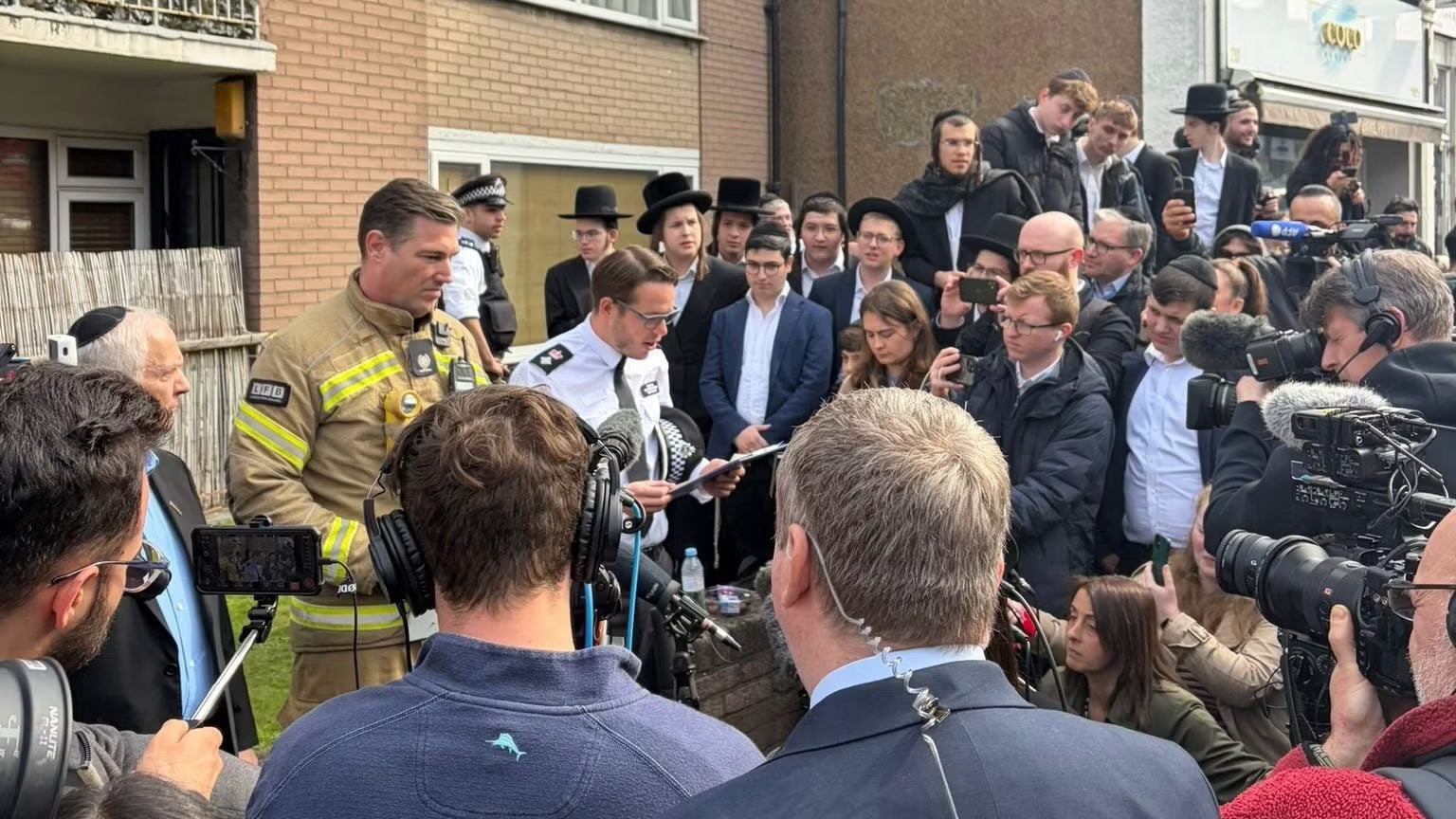
It was, by any measure, a brazen act. In the early hours of 23 March, a group of individuals set fire to ambulances belonging to Hatzola — a volunteer Jewish emergency medical service — in the car park of a synagogue in Golders Green, north London. The vehicles were reduced to wreckage. The damage, prosecutors told Westminster Magistrates’ Court on Saturday, amounted to nearly £1 million. More than the financial cost, however, it was the symbolism of the target that transformed the incident from a serious criminal act into a matter of acute national concern.
By Saturday morning, a fourth suspect had been arrested — this time, with a degree of drama unusual even by the standards of a case that has unfolded at considerable speed. The Crown Prosecution Service confirmed to the court that the individual had been apprehended at Westminster Magistrates’ Court itself, where proceedings were already under way. Officers who had recognised the man moved to detain him as he arrived at the building, the Metropolitan Police subsequently confirming the arrest of a 19-year-old on suspicion of arson with intent to endanger life.
A Premeditated Strike at a Community — and the Iranian Connection Prosecutors Cannot Yet Prove
Three suspects had already appeared in the dock before Saturday’s court hearing concluded. Hamza Iqbal, 20, and Rehan Khan, 19 — both from Leyton in east London — alongside a 17-year-old dual British-Pakistani national from Walthamstow who cannot be named for legal reasons, have each been charged with arson with intent to damage property and being reckless as to whether life would be endangered. All three were remanded in custody and will appear next at the Old Bailey on 24 April. They had been arrested on Wednesday at three separate east London addresses.
The charges themselves are serious. But it was language used by prosecutors in court that elevated the hearing beyond the realm of ordinary criminal proceedings. The attack, the court was told, bore the hallmarks of being “premeditated and targeted” against the Jewish community. More significantly still, prosecutors confirmed that investigators were actively exploring whether an Iranian-backed group — which had publicly claimed responsibility for the attack — had played any role in organising, financing or directing those involved.
This is a thread that counter-terrorism police are pulling carefully. The Metropolitan Police has been explicit that the incident has not, at this stage, been formally declared a terrorist offence. Yet the fact that counter-terrorism officers are leading the investigation rather than conventional criminal detectives speaks to the seriousness with which that avenue is being pursued. The designation question is not merely semantic: it carries implications for prosecutorial strategy, available powers, and the political framing of what occurred.
Why the Claim of Iranian Involvement Cannot Be Dismissed — or Confirmed
The assertion by an Iranian-backed group that it was responsible for the Golders Green attack arrived in a context that makes it neither implausible nor definitively credible. Iran’s use of proxies and intermediaries to conduct operations on British and European soil is well-documented. The country’s intelligence services and affiliated networks have been linked to a range of plots on UK territory in recent years, several of which have involved Jewish or Israeli-adjacent targets.
At the same time, investigators will be aware that claim of responsibility does not equal proof of involvement. Such claims can serve propagandistic purposes independent of operational reality — an opportunity to amplify fear and project reach without having directly directed an attack. The more substantive question, and the one that the ongoing investigation must answer, is whether the individuals now facing charges were acting on their own initiative, were radicalised and inspired by external actors without direct coordination, or were actively recruited and tasked by a foreign-backed network.
Two older men — aged 45 and 47 — were also arrested last week in connection with the case and released on bail until late April. Their continued presence in the investigation suggests that prosecutors may be pursuing a theory of the offence that involves a degree of planning and coordination beyond what four young men from east London could plausibly have arranged independently. That inference must be drawn cautiously, but it is not an unreasonable one.
The Community Response and the Policing Calculus
The attack landed at a moment of already-heightened anxiety within British Jewish communities. Antisemitic incidents have risen significantly in the period since October 2023, a trend that Jewish community groups have documented with mounting alarm. The targeting of Hatzola ambulances — vehicles that provide emergency medical care and are among the most benign symbols of communal self-sufficiency — carried a particular charge that went beyond the destruction of property.
Commander Helen Flanagan, head of Counter Terrorism Policing London, acknowledged the intensity of the investigative effort since the attack, describing the support from the local community as “incredible.” That language reflects something real: in complex investigations of this kind, community cooperation frequently determines how quickly suspects are identified and whether sufficient evidence can be assembled to sustain prosecution.
Police patrols have been increased in areas with significant Jewish populations, a precaution given additional weight by the timing of the attack’s legal aftermath, which coincides with Passover — one of the most significant periods in the Jewish calendar. Detective Chief Superintendent Luke Williams was careful to characterise the enhanced police presence as precautionary rather than reactive to any specific threat. The distinction matters, both for community reassurance and for avoiding the kind of generalised alarm that those behind the original attack may have hoped to provoke.
The Broader Stakes: Hate Crime, Terrorism and the Question of Foreign Interference
The Golders Green arson investigation sits at the intersection of several fault lines in contemporary British public life — the rise of antisemitic violence, the radicalisation of young men from British Muslim backgrounds, and the persistent question of how far Iranian intelligence operations have penetrated domestic networks.
Each of these is a live and sensitive issue. The risk of conflating them — or of allowing the Iranian connection claim to define public understanding of an attack that may ultimately prove to have been domestically conceived — is real. So too, however, is the risk of underestimating the significance of external influence if the evidence ultimately points in that direction.
What is beyond doubt is that four young men now face serious criminal charges for an act that caused enormous material damage, genuine fear, and a specific harm to a community that has long considered Golders Green one of its most settled and secure heartlands in Britain. The charge against three of them — being reckless as to whether life would be endangered — reflects how close the circumstances of the attack came to catastrophe. Emergency vehicles parked beside a functioning synagogue, set alight in the middle of the night, represent a risk profile that investigators will not treat lightly.
The Old Bailey hearing on 24 April will mark the next formal chapter in proceedings. Between now and then, counter-terrorism detectives will be working to determine whether the Iranian claim of responsibility is operational fact or opportunistic fiction — and whether the network behind four young men from Leyton and Walthamstow extends further than a north London car park.
