




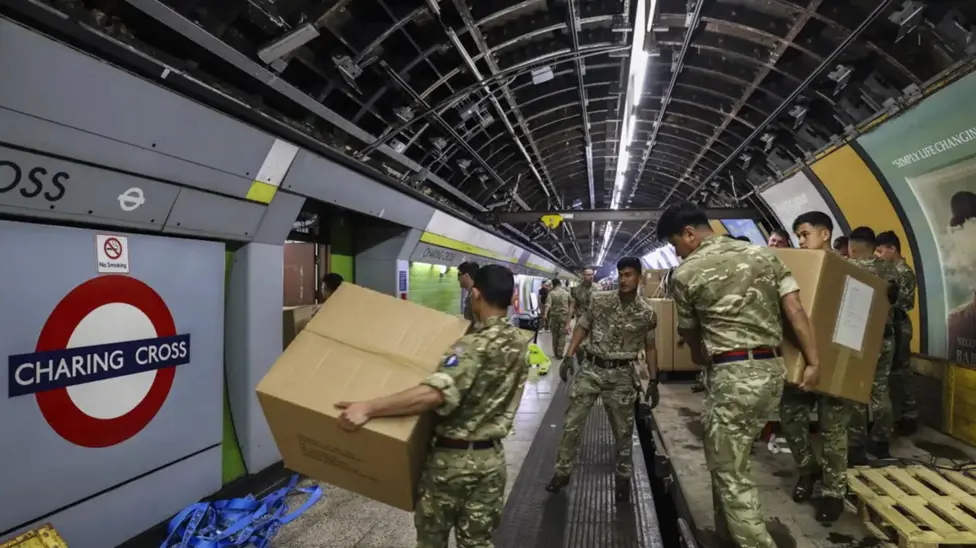
The British Army covertly took over a disused part of the London Underground in central London to plan a Nato military response to possible future Russian attacks.
Hundreds of British soldiers took part in what the army called “one of the most ambitious military exercises in a generation” in the disused platforms of Charing Cross Underground station.
Arrcade Strike was described as “a major command post exercise run by the Allied Rapid Reaction Corps (ARRC), which is Nato’s deployable corps headquarters, led by the British Army”.
It was designed to test ARRC’s ability to plan and command large-scale military operations involving about 100,000 personnel drawn from the UK and its Nato allies.
“We have moved from operating in tents and open environments, to commercial buildings, to aircraft hangars, and now to underground locations,” explained one commander during last week’s exercise.
“Operating below ground significantly reduces our signature, makes us harder to find, and improves our chances of surviving attack.”
An army spokesperson said: “It’s a lesson already being applied in Ukraine and by Nato partners on Europe’s eastern flank.
“Getting underground is not a novelty, it’s a survival strategy.”
The spokesperson added: “The Charing Cross tunnels were chosen because they’re disused, spacious enough for a full command post, and crucially, in the heart of a major city, proving the concept works even in the most complex urban environment imaginable.
“The war in Ukraine has reminded the world of a hard truth: threats to peace in Europe are not distant or theoretical.
“Russia has mobilised its entire economy, industry and military for war. The security of every Nato country is at stake.”
‘Like Stranger Things’
From the hidden underground location at Charing Cross, troops coordinated activity on land, sea, air, space and cyberspace.
The army said the exercise “was set in a fictional scenario based in 2030, because that’s when military planners believe the threat from Russia could be at its most serious”.
As much of the operation was high-tech, measures were taken to keep it covert.
Corporal Ismaila Ceesay, a 28-year-old information management specialist from Stratford, east London, said part of the exercise was arriving in civilian clothes and changing into uniform only once through the secure barriers.
He said: “I’ve reached into my London roots and adopted a London look to blend in like a local, so no-one can suspect I’m anything but a commuter going to work.
“I’ve got my hoodie on, changed my gait and I try to blend in.”
His family thought he was on leave.
He said working in the disused Tube tunnels was “like being in an episode of Stranger Things, with the red lights and the dark shadows and the fact that nothing seems quite as it should be”.
Major Joe Harris was tasked with getting a full military command post into a disused Tube station without anyone noticing.
He said: “The difference between being here and in an old warehouse, which would be our usual location, is that a warehouse would be a wide-open rectangular space, and this is a constrained layout with a warren of tunnels and train platforms.”
Harris added: “In the future, when I travel by Tube, I won’t be able to stop myself thinking you could fit a command post in here.”
