


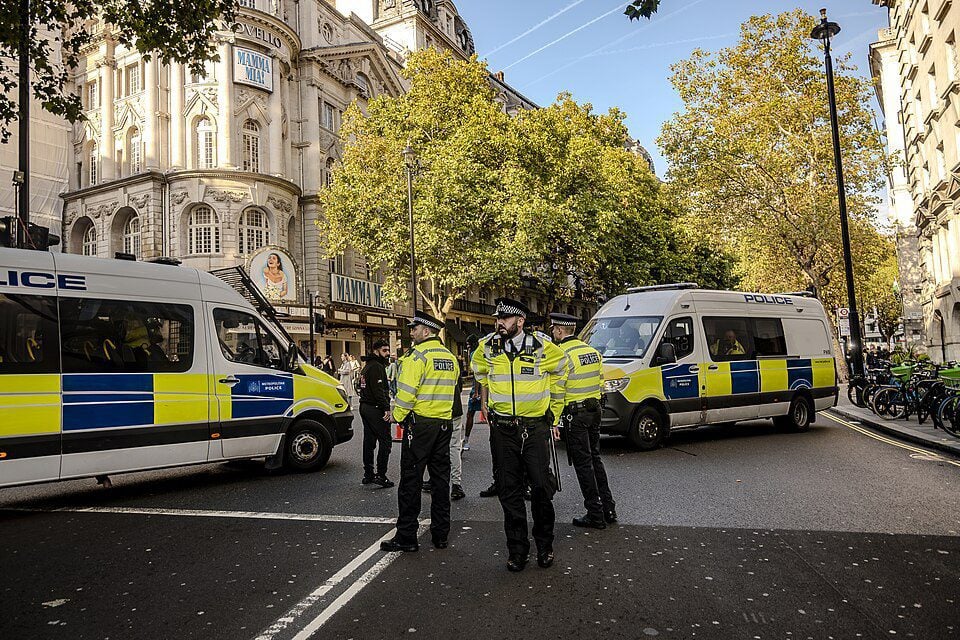
Tourists threading their way past Nelson’s Column and along The Mall on Saturday found central London transformed into a tightly controlled security zone, as the Metropolitan Police mounted one of its largest public order operations in years.
More than 4,000 officers were deployed across the capital, at a cost of about £4.5m, to keep two rival demonstrations apart: a “Unite the Kingdom” rally organised by the anti-Islam campaigner Tommy Robinson, and a pro-Palestinian march marking Nakba Day. Despite the scale of the crowds, there were no serious clashes between the two sides.
Senior officers built their plan around a “sterile zone” — a buffer of barriers, vehicles and lines of officers stretching between Trafalgar Square, Buckingham Palace and Parliament Square. Nelson’s Column was ringed with metal fencing, police vehicles lined The Mall, and a two-metre barrier sealed the road past the Foreign Office towards Whitehall. Of the officers on duty, 660 were drawn from other forces in England and Wales under so-called mutual aid arrangements. ITV News reported that around £1.7m of the operation’s cost went on those reinforcements.
The need for such an operation stemmed from a scheduling clash. Pro-Palestinian groups hold a march each year on the weekend nearest 15 May to mark the Nakba, the displacement of Palestinians who fled or were driven from their homes during the war surrounding Israel’s creation in 1948-49. When organisers approached the Met about this year’s date, however, they found that 16 May had already been booked by Robinson, whose real name is Stephen Yaxley-Lennon, for one of his rallies. After negotiations, both events were allowed to proceed. The BBC reported that the decision left the force facing a significant security headache, made heavier still by the FA Cup Final taking place at Wembley the same afternoon.
Police concern was shaped in part by Robinson’s previous rally last September, which the BBC estimated drew around 150,000 people and saw some supporters fight running battles with officers near anti-racism campaigners. The Met has described Saturday’s deployment as among its most significant since the May Day disorder of the early 2000s.
To keep the crowds separated, the two marches were given carefully divided routes. Unite the Kingdom supporters walked from Holborn, along the Strand and down Whitehall to a rally in Parliament Square, while those on the pro-Palestinian march moved from Knightsbridge along Piccadilly and into Pall Mall for their speeches. The plan, the BBC reported, appeared to have largely worked.
For the first time at a protest, the Met used live facial recognition cameras, positioned at Euston and King’s Cross St Pancras stations, where many of those attending the Robinson rally were expected to arrive. ITV News reported that two men were arrested near Euston on suspicion of grievous bodily harm in connection with an incident in Birmingham on Thursday, in which a man was run over by a car following an altercation linked to the Raise The Colours group, which has been attaching flags to lampposts across the country. The technology was not universally welcomed. ITV News reported that the Biometrics and Surveillance Camera Commissioner, Professor William Webster, warned that forces using it could face legal challenges, describing the system as not “foolproof”.
By 19:30 BST, the Met said 43 people had been arrested across the two protests, with a further 22 detained at the FA Cup Final. In an update on Sunday morning, the force said 20 of those arrested were affiliated with the Unite the Kingdom march and 12 with the Nakba demonstration, while 11 were either unaffiliated or could not be confirmed. Eleven arrests related to alleged hate crime offences — nine connected to the Robinson rally and two to the Nakba march — with a further seven alleged hate crime offences at the pro-Palestinian event still under investigation. ITV News reported that four officers were assaulted, none seriously, and that six were subjected to hate crime offences.
Throughout the afternoon, police helicopters monitored the marches from above and dog units waited in vans on Horse Guards Parade. The Met’s new SandCat armoured vehicles were kept out of sight, with officers saying they were on hand only for situations involving “extreme violence”. Deputy Assistant Commissioner James Harman, who put the operation’s cost at about £4.5m, told CBS News the events had passed “largely without significant incident”. The Crown Prosecution Service’s director, Stephen Parkinson, said the approach was “not about restricting free speech” but about “preventing hate crime and protecting the public, particularly at a time of heightened tensions”, according to Al Jazeera. Prime Minister Sir Keir Starmer, quoted by ITV News, said the Unite the Kingdom organisers were “spreading hatred and division”, but stressed that “peaceful protest is a fundamental right and one I will always protect”.
An early police estimate put the Unite the Kingdom turnout at around 60,000, less than half the number seen in September. The BBC noted that Saturday’s event carried less edge than the earlier rally. Several high-profile overseas speakers were unable to attend after the government revoked their right to enter the UK; among them were the Colombian-American influencer Valentina Gomez, the Polish MEP Dominik Tarczynski and the Canadian commentator Ezra Levant. The US technology billionaire Elon Musk, who addressed September’s rally by video link with the words “Fight back or die!”, was also absent on Saturday, though Robinson thanked him for his support.
